
GYST: Redesigning onboarding for the overwhelmed digital creative
How do you design an AI analytics tool that makes a million-dollar content creator feel smart, not stupid?
GYST is an AI-powered revenue intelligence tool for elite content creators. It functions as a conversational CFO that translates complex business data into plain language insights by comprising content analytics from several platforms into one metrics overview.
Our brief was to redesign the onboarding experience for first-time users. The challenge wasn't technical, it was human. How do you welcome someone who is brilliant at building things, but intimidated by data?
This case study documents how we answered that question and what I learned about designing for cognitive ease, accessibility, and emotional trust.
about
role
Ux/ui, navigation, user flow, persona development, narrative structure
tools
figma, protopie,
photoshop
year: 2026
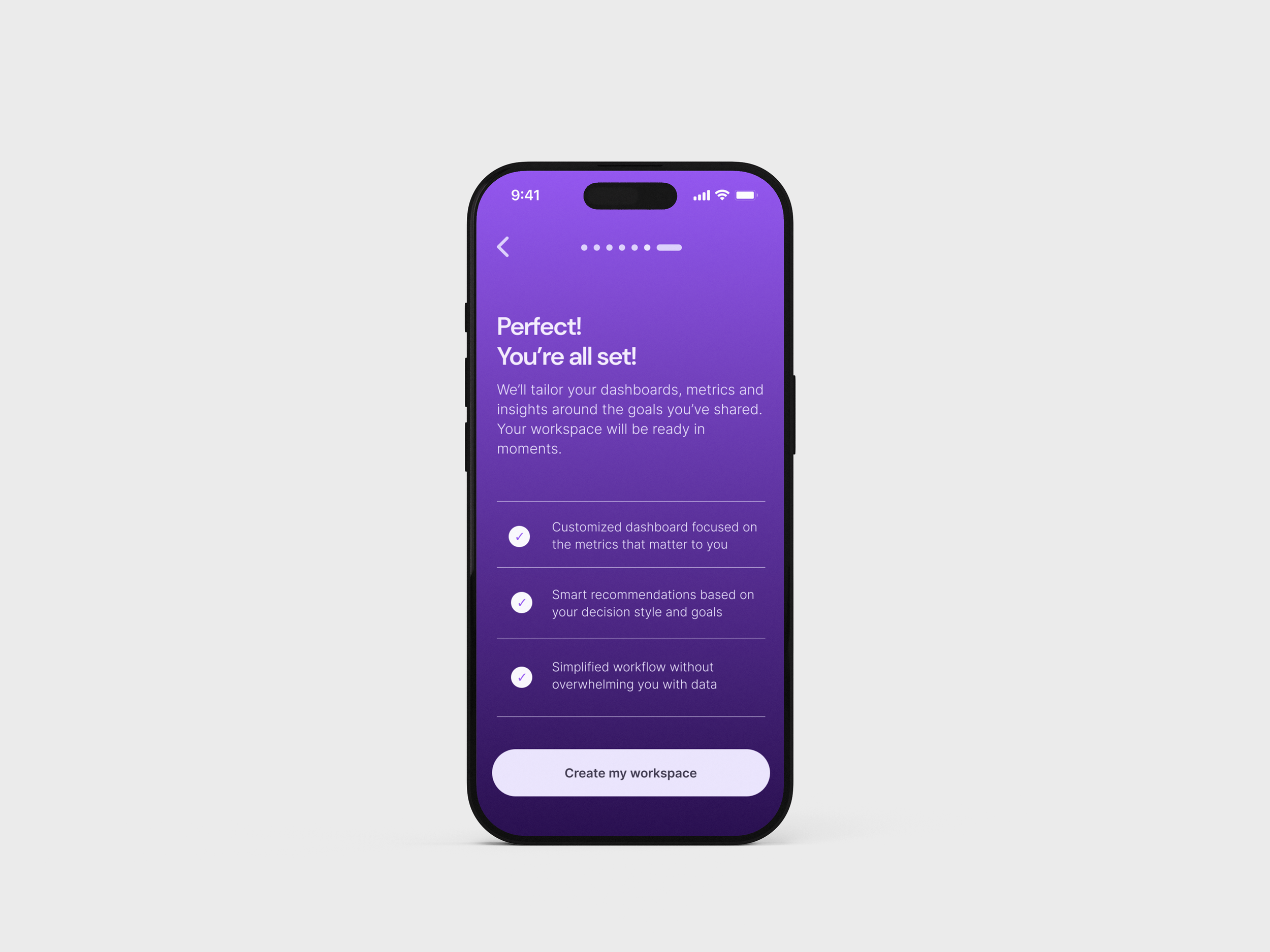
Content creators in the top 5% of earners manage revenue across eight or more platforms simultaneously. Their data lives in places such as YouTube Studio, TikTok Analytics, and Patreon.
Existing analytics tools are built for analysts, not creators. They're static, text-heavy, and cognitively demanding. As a result, creators avoid their own data, make pricing decisions on intuition, and leave money on the table. GYST's promise is to change this.
However, a powerful tool means nothing if users abandon it during onboarding. Three critical pain points emerged from our User Journey Map:
Cognitive overload at first contact: too much information before the user understands the value
No clear value moment: setup requires effort before anything useful is shown
Platform fragmentation: connecting eight data sources feels like a chore, not a feature
challenge
To design the right experience, we needed to understand who we were designing for. We decided to spend time and care on establishing our user persona since the context around the onboarding was defined by mental exhaustion, uncertainty, and frustration.
Jess is a US-based creator-operator running a multi-platform media and wellness business generating $10–500M annually. She has a small, high-leverage team. She makes decisions about pricing, sponsorships, and product strategy, often without complete data. She's not analytically trained. She's dyslexic. And she's built something remarkable while quietly feeling like she doesn't understand her own business. Her words:
"i built a million-dollar business but feel stupid looking at a spreadsheet."
Jess became our design compass. Every decision (typography scale, skip options, voice interaction, progressive disclosure…) was filtered through one question: does this make Jess feel capable, or does it make her feel behind? Designing for Jess means designing for everyone.
Expanding Jess into a psychologically rich persona was my core contribution to this project. Understanding her emotional landscape such as her anxiety around data, her pride in what she's built, how dyslexia shapes her relationship with interfaces gave the whole team a shared language for design decisions.
behind the screen:
our user persona
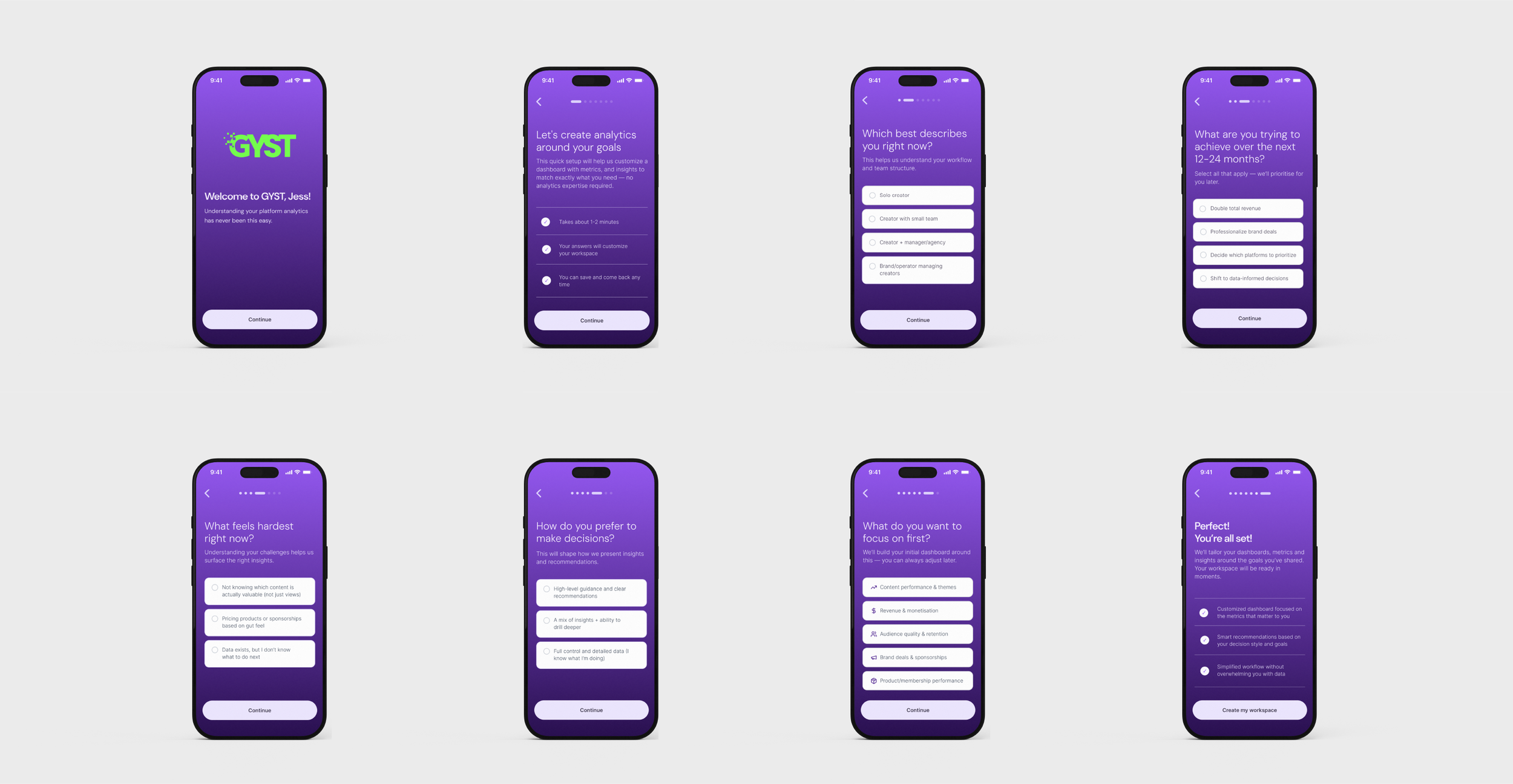
Our process moved from research to narrative to structure to design. The central design challenge was sequencing. When do you ask for effort? When do you show value? Where does friction serve the user, and where does it lose them?
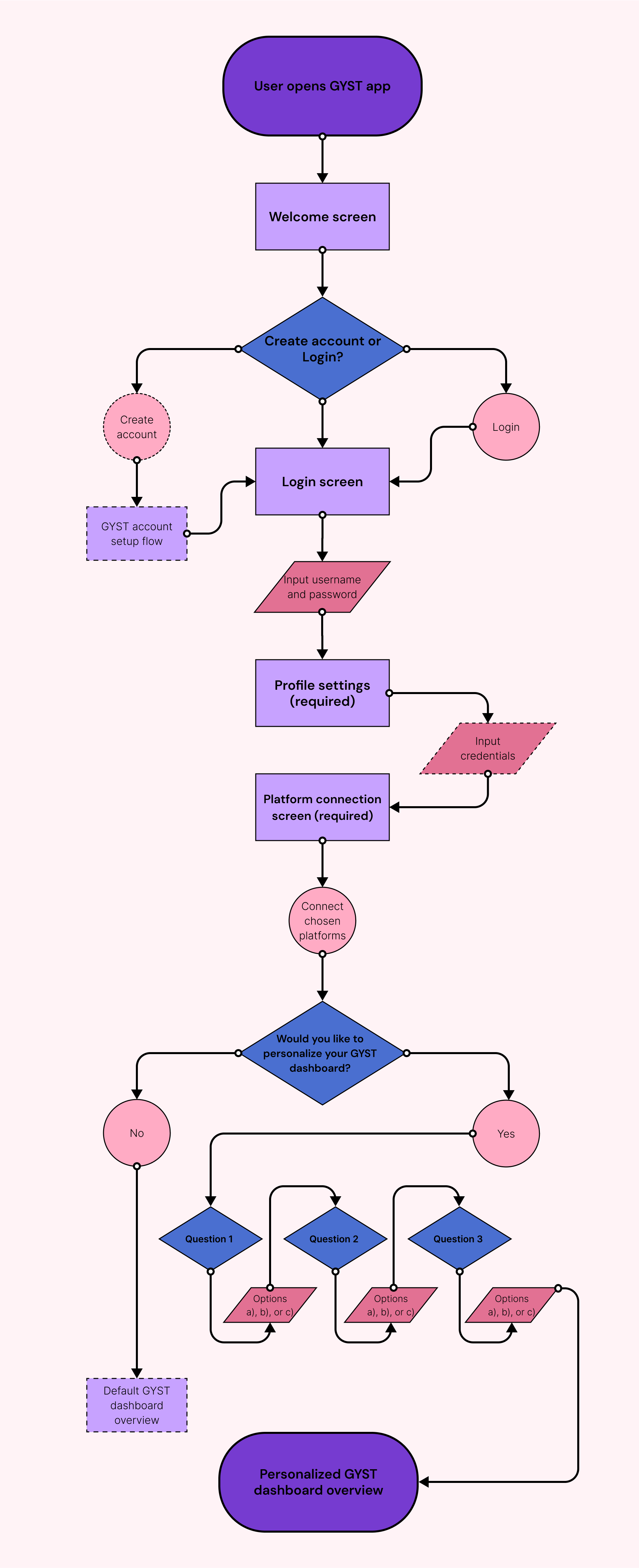
We arrived at a three-stage structure:
Soft setup first: connect platforms, get data flowing. Immediate value before customization is requested.
Questionnaire second: five focused questions, always skippable, both educating Jess and GYST about each other.
Deep setup last: accessible overview with information that is actually meaningful to Jess, informed by data GYST has already collected.
This sequence respects Jess's time and cognitive load. She sees her business before she's asked to configure anything, and she also understands her data. We created a dashboard model that could grow as the user learns and their business evolves, always with the possibility to update the metrics and depth.
process
-
We began with an AS-IS User Journey Map, walking through GYST’s existing onboarding to identify where Jess would encounter friction. Three serious pain points shaped everything that followed.
-
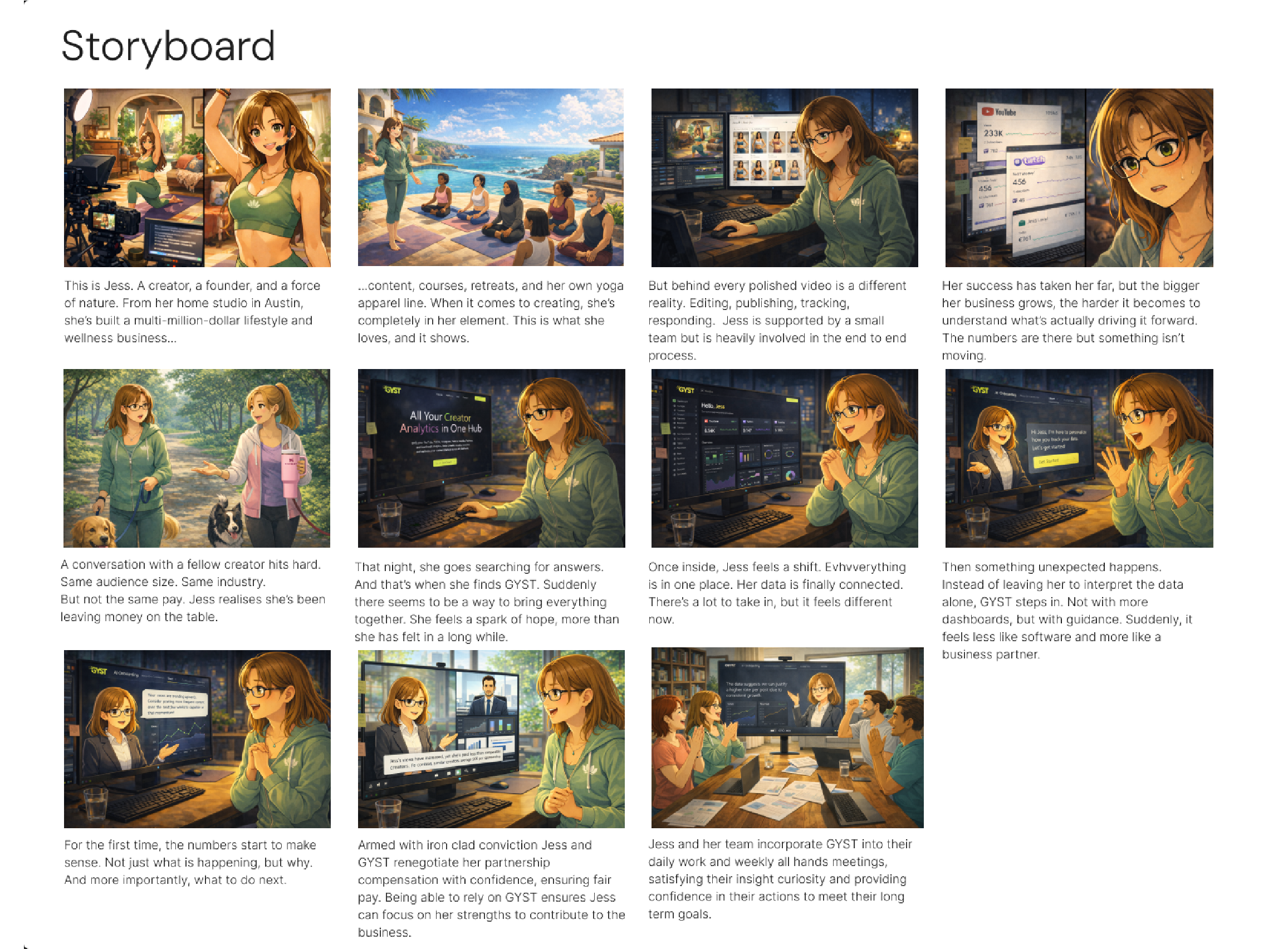
From there, we developed a TO-BE storyboard, a speculative narrative showing Jess’s improved journey, from discovery through to her first genuine insight. The storyboard became the spine of the entire project , every design decision was evaluated against the story it told.
-
The user flow translated our new story into a functional user journey, complete with decision points, skip logic, and platform connection flows. I developed this in Figma, applying standard UX conventions (circles for actions, diamonds for decisions, rectangles for screens) to create a diagram that was both a working tool and a presentation artifact.
-
In parallel, the team developed a handoff-ready design system in Figma, including variables, tokens, semantic color naming, and light/dark mode variants. This gave our mid-fidelity mockups consistency and our ProtoPie prototype a reliable visual foundation, and it enabled a seamless hand-off from mid-fi to the developers.
One of GYST's core promises is that it speaks human, not spreadsheet. We carried this into every screen, not just the AI responses, but the onboarding copy, button labels, error states, and empty states. "Connect your platforms" instead of "Integrate data sources." "What matters most to you?" instead of "Select primary KPIs." The language signals: this tool is on your side.
The final deliverable was a mid-fidelity Figma mockup, a handoff-ready design system, and a ProtoPie prototype demonstrating our interface.
Presented to the client in February 2026, the project demonstrated how accessibility, narrative structure, and user-centered onboarding design can work together to reduce friction and build emotional trust. For Jess, the measure of success is simple: she completes onboarding, sees something useful immediately, and comes back the next day.